
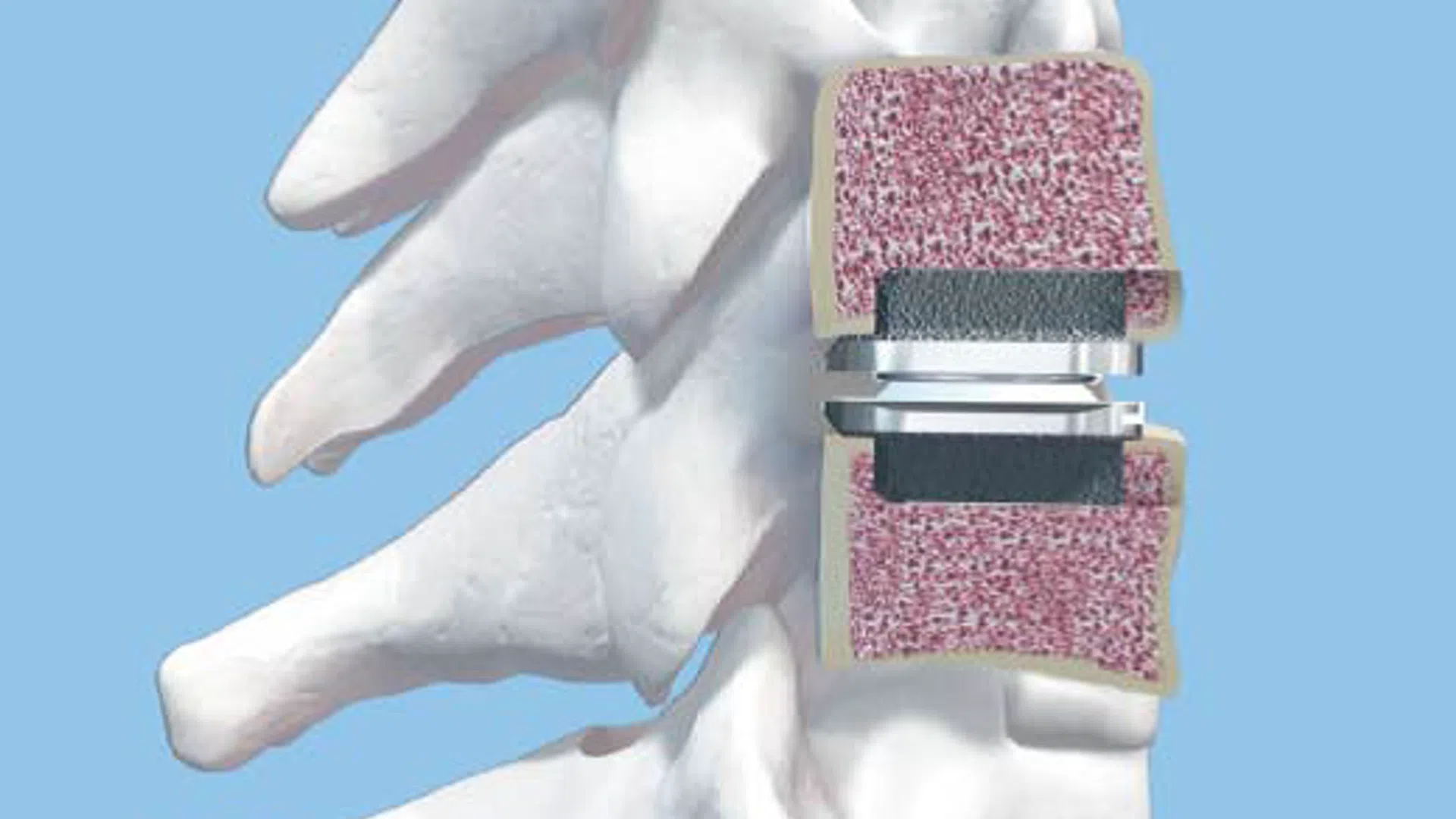
Artificial Disc Replacement
A Motion Preservation Surgery
An artificial disc replacement, also called total disc arthroplasty, is a surgery that removes a damaged spinal disc and replaces it with a man-made device. Unlike spinal fusion, which joins bones together and limits movement, this procedure is designed to keep the spine moving more naturally while helping reduce pain.
How Artificial Disc Replacement Works
- The Approach: The surgeon usually reaches the spine from the front, either through the neck for a cervical disc or through the abdomen for a lumbar disc. This gives direct access to the disc without going through the spinal cord or large back muscles.
- Disc Removal: The damaged disc is taken out completely. The surgeon also removes bone spurs or loose pieces that may be pressing on nearby nerves.
- Implantation: The artificial disc is placed into the empty space. It is usually made of two metal plates, often titanium or cobalt-chromium, with a medical-grade plastic center. The metal plates attach to the bones above and below, while the plastic center allows the spine to bend and move.
Why It Is Performed
This surgery is often used for severe degenerative disc disease or a herniated disc that causes long-lasting neck, back, arm, or leg pain. Many people choose it instead of fusion because it can:
- Preserve motion: It helps keep a more natural range of movement, including bending and twisting.
- Protect nearby discs: Since the spine keeps moving more normally, there is less extra stress on the discs next to the treated area.
Who Is a Good Candidate?
- Not everyone with back pain is a good fit for disc replacement. It is usually best for people who:
- Have ongoing pain coming from one or two discs
- Do not have severe arthritis in the facet joints
- Do not have major spinal instability, scoliosis, or severe osteoporosis
Recovery and What to Expect
Hospital stay:
Cervical disc replacement is often done as an outpatient procedure or may require one night in the hospital. Lumbar disc replacement usually requires a 1 to 2 night stay.
Faster movement:
Since there is no bone graft that needs time to fuse, patients are often encouraged to walk soon after surgery.
Recovery rules are usually less strict than with fusion.
Timeline: Many patients can return to light activity or desk work in 2 to 4 weeks. A full return to more active tasks often takes about 2 to 3 months.


