

Robotic Knee Replacement in Memphis & Mid-South
Personalized Robotic Knee Resurfacing
Severe knee arthritis does not have to mean a long hospital stay or weeks of being stuck in bed for a knee replacement procedure. At OrthoSouth, our fellowship-trained joint replacement surgeons use advanced robotic-assisted technology to create a knee replacement plan made for your body and your needs.
With detailed 3D planning before surgery and precise guidance during the procedure, we can protect healthy bone and ligaments, reduce damage to surrounding tissue, and help many patients go home the same day.
Tailored to Your Natural Motion
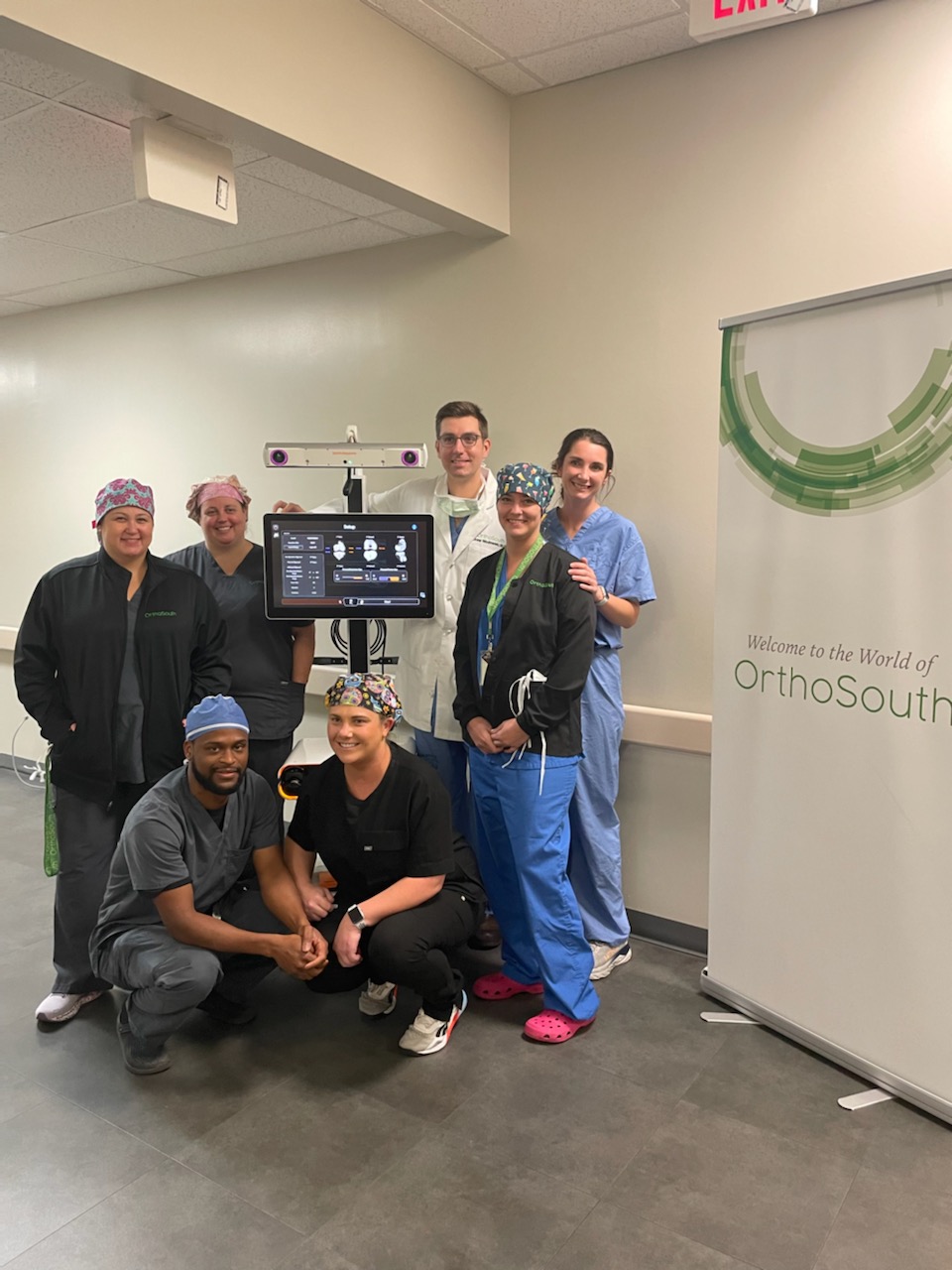
At OrthoSouth, we use robotic-assisted knee replacement to help make surgery more precise and personalized for each patient.
Instead of relying only on standard cutting guides, robotic technology gives your surgeon a detailed 3D view of your knee. This helps map the exact shape of your joint, including bone contours, wear patterns, and how your knee moves and balances.
With this added precision, your surgeon can prepare the bone within very exact boundaries. That means healthy bone and soft tissue around the knee can be protected as much as possible during surgery.
Robotic assistance also helps your surgeon fine-tune ligament balance throughout the range of motion. The goal is to create a knee that feels stable and natural when you walk, climb stairs, or bend.
For some patients, robotic technology may also make partial knee replacement possible. If the arthritis is limited to just one part of the knee, your surgeon may be able to resurface only the damaged area while preserving more of your natural knee, including important ligaments like the ACL and PCL.
If you are thinking about knee replacement, robotic-assisted surgery may offer a more tailored approach designed around your unique knee and your recovery goals.
Same-Day Outpatient Recovery: The Surgery Center Advantage
Advanced surgical technology is helping to make knee replacement less disruptive and recovery more manageable. By reducing tissue trauma during surgery, many patients have less swelling after the procedure, need fewer narcotic pain medicines, and reach physical therapy goals sooner.
Go Home the Same Day. For eligible patients, robotic joint resurfacing can be done at our Germantown Surgery Center or Southaven Surgery Center. That means no hospital admission and the comfort of recovering at home just hours after surgery.
Lower Risk of Infection. Outpatient surgery centers often have lower infection and complication rates than large hospital systems. That added level of safety can give patients greater peace of mind before surgery.
Get Moving Within Hours. With advanced pain control and tissue-sparing robotic techniques, many patients are able to stand and take their first steps the same afternoon. Our physical therapy team is there to help you start strong.
Clearer, Lower Out-of-Pocket Costs. Outpatient surgery centers avoid unnecessary hospital facility fees, which can make the process more transparent and more affordable for many patients and insurance plans.
If knee pain is keeping you from the life you want, OrthoSouth is here to help you move forward with confidence.
Advanced Robotic Systems: Mako & CORI Technology
At OrthoSouth, we reject one-size-fits-all orthopedic surgery. Every patient's joint geometry, bone density, and ligament balance are distinct. That is why our surgical teams utilize a number of sophisticated, clinically proven robotic platforms, including: Stryker's Mako SmartRobotics™ and Smith & Nephew's CORI Surgical System.
While both systems provide sub-millimeter surgical precision, each offers unique technological strengths. Your OrthoSouth surgeon selects the techniques he or she uses in surgery based on a mix of your specific joint anatomy, surgical goals, individual lifestyle demands, and their deep knowledge and training.
Mako SmartRobotics™: 3D CT-Based Planning & Haptic Guidance
The Mako system pairs pre-operative computed tomography (CT) imaging with active haptic robotic arm guidance to deliver predictable, patient-matched joint alignment.
- CT-Derived 3D Virtual Model: Before surgery, a low-dose CT scan creates a detailed 3D model of your knee. This gives your surgeon a clear view of your unique anatomy and helps plan your procedure with a high level of accuracy.
- Pre-Operative Virtual Surgery: Using that model, your surgeon can map out the surgery ahead of time, including implant size, position, angle, and depth. This careful planning helps create a knee replacement that is tailored to your body and your goals.
- Active Haptic Boundary Protection: During surgery, your surgeon stays in control while the Mako robotic arm provides guided support. The system helps protect healthy bone and nearby soft tissue by keeping the surgical tools within the planned treatment area. This added precision can help your surgeon work with confidence and care.
- Dynamic Intraoperative Balancing: Mako also gives real-time feedback during the procedure, allowing your surgeon to make fine adjustments to help balance the knee and support smooth movement.
CORI Surgical System: Handheld, Image-Free Robotic Resurfacing
The CORI platform gives your surgeon precise control in the operating room without the need for a pre-op CT scan. This can sometimes mean a simpler, faster path to surgery with advanced technology guiding every step.
Real-Time Mapping of Your Knee. Using optical tracking and digital sensors, the system helps your surgeon map your knee in real time. By collecting key surface points, CORI builds a detailed 3D model of your joint so your surgeon can see the shape of the bone and cartilage with relative accuracy.
Handheld Robotic Precision During Surgery. CORI uses a handheld robotic tool that follows your surgeon's movements while staying within your custom surgical plan. If the tool reaches the edge of the planned area, the cutting burr stops spinning. That added safeguard can help protect healthy bone and supports very exact preparation of the joint.
A Faster Path to Outpatient Knee Surgery
Both OrthoSouth surgery centers possess a CORI robotic system, which helps streamline the process from consultation to surgery for those patients who are candidates for outpatient surgery. For the right patient, that can make same-day total or partial knee replacement more efficient and more convenient.
If you are searching for a knee replacement surgeon who uses advanced technology to match treatment to your needs, robotic-assisted care may be a strong option to discuss.
Meet Our Fellowship-Trained Robotic Joint Replacement Surgeons
Total vs. Partial Robotic Knee Replacement
Not all knee arthritis requires a complete joint overhaul. The knee is divided into three distinct anatomical compartments: the medial (inner), lateral (outer), and patellofemoral (front, beneath the kneecap). Depending on whether your cartilage wear is widespread or isolated to a single zone, robotic-assisted technology allows our surgeons to tailor the procedure to your exact stage of joint degradation.
During your comprehensive evaluation, our joint replacement team uses weight-bearing digital imaging and physical joint stability assessments to determine whether a total joint replacement or a targeted, bone-preserving partial resurfacing is your best path forward.
Precision Total Joint Replacement: Restoring Complete Stability & Alignment
When severe osteoarthritis, rheumatoid arthritis, or post-traumatic damage affects two or more compartments of the knee, a robotic total knee replacement provides definitive, lasting relief.
- Full-Joint Rebalancing: A total knee replacement involves removing the damaged cartilage and bone ends across all three compartments and capping them with durable, biocompatible metal and medical-grade polyethylene implants.
- Eliminating Mechanical Deviation: Robotic total knee systems calculate the precise coronal and sagittal alignment of your entire leg. This corrects common deformities—such as severe bowleggedness (varus) or knock-kneed alignment (valgus)—and distributes body weight evenly across the new joint to prevent premature implant wear.
- Customized Soft-Tissue Balancing: Traditional total knee surgeries often rely on standardized releases of surrounding ligaments to make the knee fit a generic implant. Robotic total knee surgery flips this equation: your surgeon micro-adjusts the implant's positioning to match your body's natural ligament tension, yielding a joint that feels stable, fluid, and natural under load.
- Long-Term Durability for Active Lifestyles: With computer-verified component alignment, robotic total knee replacements reduce mechanical friction and edge-loading, extending the lifespan of your implant for decades of pain-free walking, golfing, cycling, and travel.
Bone-Preserving Partial Knee Arthroplasty: Resurfacing Only What Is Damaged
For approximately 20% to 30% of patients with knee arthritis, damage is confined entirely to a single compartment—most commonly the inner (medial) side of the joint. Rather than replacing the entire joint, robotic partial knee arthroplasty (unicompartmental resurfacing) targets solely the diseased section while preserving the rest of your natural knee.
- Preserving Natural Cruciate Ligaments: Unlike a total knee replacement, a partial knee procedure leaves your anterior cruciate ligament (ACL) and posterior cruciate ligament (PCL) completely untouched. Preserving these native ligaments maintains your body's natural proprioception (joint-position sense), meaning your knee feels like your knee, rather than an artificial joint.
- Minimal Bone Removal: Robotic haptic boundaries and optical mapping allow surgeons to shave away only millimeters of arthritic bone in the compromised compartment. Your healthy cartilage, bone structure, and surrounding soft tissues in the other two compartments remain intact.
- Smaller Incisions & Minimal Blood Loss: Because the surgical field is confined to a single compartment, incisions are significantly smaller, resulting in less muscle disturbance, minimal blood loss, and reduced post-operative swelling.
- Accelerated Outpatient Recovery: Patients undergoing robotic partial knee resurfacing experience a shorter rehabilitation timeline. Most patients walk unassisted within days, experience minimal post-operative discomfort, and return to recreational activities significantly faster than with traditional total joint arthroplasty.
Outpatient Knee Surgery at Our Award-Winning Surgery Centers

The Outpatient Surgery Center Advantage: Recover Where You’re Most Comfortable
Undergoing a joint replacement no longer requires days in a hospital bed. Through a combination of robotic surgical precision, advanced multimodal pain protocols, and specialized clinical care, OrthoSouth has transitioned modern joint replacement into a streamlined, same-day outpatient experience.
Eligible patients have their procedures performed at our state-of-the-art ambulatory surgery centers (ASCs)—including the Germantown Surgery Center and Southaven Surgery Center—allowing you to begin your recovery in the quiet comfort of your own home just hours after surgery.
1
Instead of spending nights in a noisy hospital room with frequent disruptions, you return home the afternoon of your surgery. Studies consistently show that resting in a familiar environment improves sleep quality, reduces stress levels, and fosters a more positive recovery mindset. With your personalized home-recovery plan and support system in place, you rest in your own bed while our care team closely monitors your progress.
2
Hospital environments care for a wide range of acute illnesses and infectious diseases. Ambulatory surgery centers, by contrast, focus exclusively on elective, planned surgical procedures for healthy, screened patients. This specialized environment results in substantially lower surgical site infection (SSI) rates and fewer post-operative complications compared to traditional hospital settings.
3
Our ASC clinical teams specialize entirely in orthopedic care. From pre-op preparation to post-anesthesia recovery, every nurse, surgical technician, and therapist is trained specifically in joint reconstruction. Under our rapid-recovery protocol, physical therapists work with you to stand and take your first steps within hours of your procedure, confirming joint stability and balance before you head home.
4
Hospital-based procedures carry hefty "facility fees" that drive up total healthcare costs. ASCs operate with streamlined, efficient overhead, translating into significantly lower facility charges. For patients with high-deductible commercial insurance or co-insurance requirements, choosing an outpatient surgery center can reduce out-of-pocket expenses by thousands of dollars for the exact same surgical procedure and implant.
5
Without emergency trauma cases or hospital room backlogs bumping scheduled surgeries, our ASC operating rooms run on a predictable schedule. Your arrival, surgery, and discharge times are streamlined, minimizing pre-procedure waiting and unnecessary anxiety for you and your family.
Note: Outpatient joint replacement is ideal for motivated patients in good overall health with adequate home support. During your initial consultation, your OrthoSouth surgeon will evaluate your medical history to ensure same-day surgery is safe and appropriate for you.
Frequently Asked Questions About Robotic Knee Replacement
What is the difference between robotic knee replacement and traditional knee replacement?
Rather than relying strictly on mechanical cutting blocks, robotic-assisted knee replacement utilizes computerized 3D planning and real-time optical or haptic guidance. This allows surgeons to plan and prepare bone within sub-millimeter boundaries, protecting healthy ligaments and balancing soft tissue dynamically across the knee's full arc of motion.
What robotic knee systems are available at OrthoSouth?
OrthoSouth surgeons utilize both Stryker Mako SmartRobotics, which features pre-operative CT modeling and haptic boundary protection, and the Smith & Nephew CORI Surgical System, an image-free handheld optical tracking platform equipped at both OrthoSouth surgery centers.
Can robotic knee replacement be performed as same-day outpatient surgery?
Yes. For eligible candidates, robotic total and partial knee replacement is performed at the OrthoSouth Germantown Surgery Center or Southaven Surgery Center, allowing patients to bypass hospital admissions and return home hours after surgery.
What are the advantages of robotic partial knee replacement over total knee replacement?
If joint damage is confined to a single compartment, robotic partial knee resurfacing targets only the arthritic section while leaving the anterior cruciate ligament (ACL) and posterior cruciate ligament (PCL) completely intact. This maintains natural joint kinematics, requires smaller incisions, and accelerates rehabilitation.
Does the robotic system perform the surgery automatically?
The robot does not operate on its own; the surgeon remains in control throughout the procedure. Robotic technology assists the surgeon, but it is not capable of performing surgery independently.
How long is recovery after robotic knee replacement?
Recovery after robotic knee replacement varies from person to person, but many patients start moving much sooner than they expect. Some people stand and take a few steps within hours of surgery, and many go home the same day if they are a good candidate. Robotic technology may help make recovery smoother by allowing for more precise surgery and less damage to nearby tissue. However, the best surgical technique is the one your surgeon is comfortable performing.
Am I a candidate for partial knee replacement instead of total knee replacement?
Partial knee replacement may be a good option if arthritis is limited to just one part of your knee. If damage is spread across the whole joint, total knee replacement is usually the better choice.
To know which option fits you best, your surgeon will look at your X-rays, symptoms, knee stability, and overall health. They will also check how much of the knee is worn down and whether the healthy parts of the joint are still working well.
You may be a candidate for partial knee replacement if:
- The arthritis is in only one compartment of the knee
- Your ligaments are still strong and stable
- You have good knee motion
- The rest of the knee is still in good shape
- Your pain and stiffness are not caused by widespread joint damage
You may need total knee replacement if:
- Arthritis affects more than one part of the knee
- Your knee is badly deformed or unstable
- You have severe bone and cartilage loss
- Past injuries or arthritis have damaged the whole joint
The best way to find out is through an exam and imaging tests. An OrthoSouth knee specialist can tell you whether partial knee replacement could give you relief while preserving more of your natural knee.
